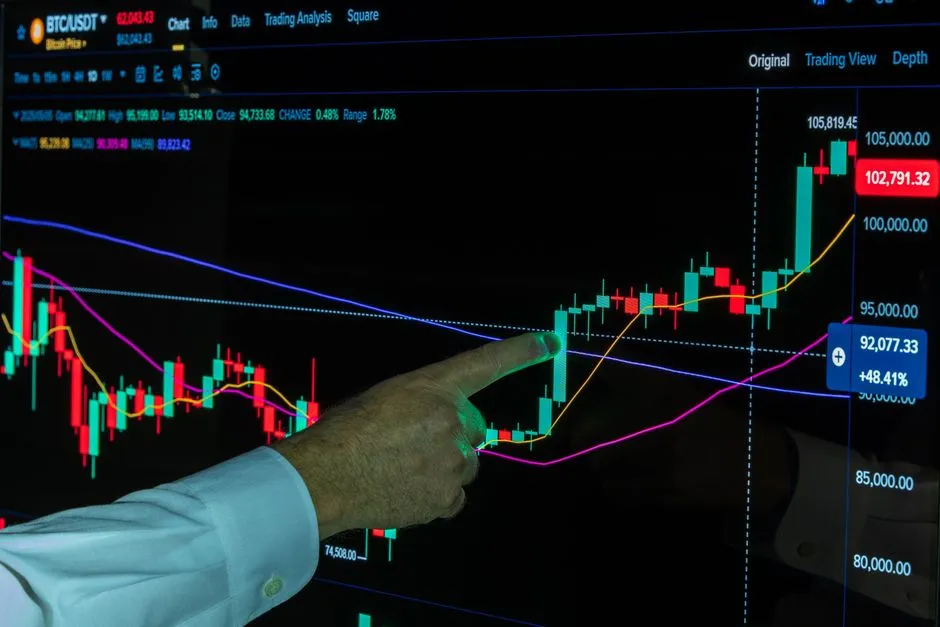
Bitcoin is once again showing a cautious tone as price action and onchain signals point to weakening short-term demand. After a brief rebound in August, one of Bitcoin’s apparent demand indicators has slipped back into negative territory, adding to the sense that buyers are not yet in full control of the market. At the same time, BTC has struggled to hold above the $77,000 level, with the price dipping below that threshold amid a broader risk-off move across bonds and equities.
For many market watchers, this is less about a single price level and more about what that level reveals about market psychology. When Bitcoin hovers near a major round number, it often becomes a reference point for traders, institutions, and retail investors alike. If buyers can defend the area, confidence tends to improve. But when the price slips below it, especially while onchain demand signals weaken, the market can look more vulnerable to further pullback.
What the negative demand signal may mean
Onchain demand indicators are useful because they try to look beneath raw price movement and measure actual buying pressure from participants on the Bitcoin network. When an apparent demand signal turns negative, it generally suggests that sellers have more influence than buyers, or that demand is not strong enough to absorb selling pressure comfortably. In other words, the market may be moving less because of aggressive accumulation and more because of hesitation, profit-taking, or reduced appetite for risk.
That does not automatically mean a major downturn is underway. Onchain signals can be noisy, and short-term dips are common even in healthier markets. Still, the fact that this indicator turned negative again after a short-lived August improvement is worth noting. It suggests that the earlier recovery may have been shallow, and that demand has not yet stabilized in a way that supports a stronger continuation to the upside.
Why the $77,000 area matters
Round numbers tend to matter in crypto markets, partly because they are easy to remember and partly because they often cluster with trading activity, options positioning, and investor sentiment. In Bitcoin’s case, the $77,000 zone has become a notable point of interest during the current market cycle. When BTC trades just above it, buyers may feel reassured. When it falls below, the level can flip from support to resistance, making a quick recovery more difficult.
Price action around a key level like this often tells a story about control. A clean rejection from $77,000 can trigger stop-loss orders, reduce momentum, and encourage traders to wait for clearer direction. On the other hand, a firm reclaim of that level could suggest that dip-buyers are still active and that the broader market may be closer to stabilizing than it appears at first glance.
The macro backdrop is adding pressure
Bitcoin rarely moves in isolation. It is often influenced by the broader financial environment, including interest rates, dollar strength, equity market sentiment, and bond market conditions. In this case, the weakness in BTC has come alongside a wider sell-off in bonds and equities, which points to a more defensive risk posture across asset classes.
When investors reduce exposure to riskier assets, Bitcoin can come under pressure, particularly if it is being traded more like a high-beta growth asset rather than a purely standalone store of value. A bond and equity sell-off can signal concerns about liquidity, economic growth, or rate expectations, all of which can affect how aggressively investors are willing to hold volatile digital assets.
This macro context is important because it helps explain why Bitcoin may struggle even when some onchain metrics do not point to extreme distress. In other words, the weakness may not be coming solely from Bitcoin-specific selling. It may also be the result of a broader market pullback that is reducing appetite for risk across the board.
What this means for traders and investors
For traders, the combination of negative apparent demand and price weakness below $77,000 suggests a need for patience. Entering a market that is still searching for a base can be risky, especially if liquidity is thin or volatility remains elevated. Many traders will likely wait for clearer confirmation before committing to a stronger directional move.
For longer-term investors, the situation is more nuanced. Short-term demand signals can be frustrating to watch, but they do not always determine the ultimate path of an asset. What matters most is whether demand eventually returns, whether price stabilizes, and whether the broader macro environment improves. If apparent demand remains negative for an extended period while BTC continues to lose key levels, it could increase the risk of a deeper correction. But if buyers step back in and the price reclaims the $77,000 area, the market could regain momentum.
Key levels and signals to watch
Going forward, there are a few factors that may help clarify where the market is heading:
- Reclaiming $77,000: A move back above this level would be a bullish sign, suggesting that buyers are able to defend a key area after the recent slip.
- Recovery of positive demand: If the onchain apparent demand indicator turns positive again, it could signal that underlying buying pressure is returning.
- Broader risk asset performance: Since bonds and equities are also under pressure, Bitcoin may continue to be influenced by macro sentiment. A stabilization in those markets could help ease the pressure on crypto.
- Volume and participation: Strong price moves on low volume often lack durability. A recovery supported by higher participation would be more meaningful than a quiet bounce.
Related read: XRP Ledger Surpasses 3 Billion Transactions: What the Milestone Means for Network Adoption