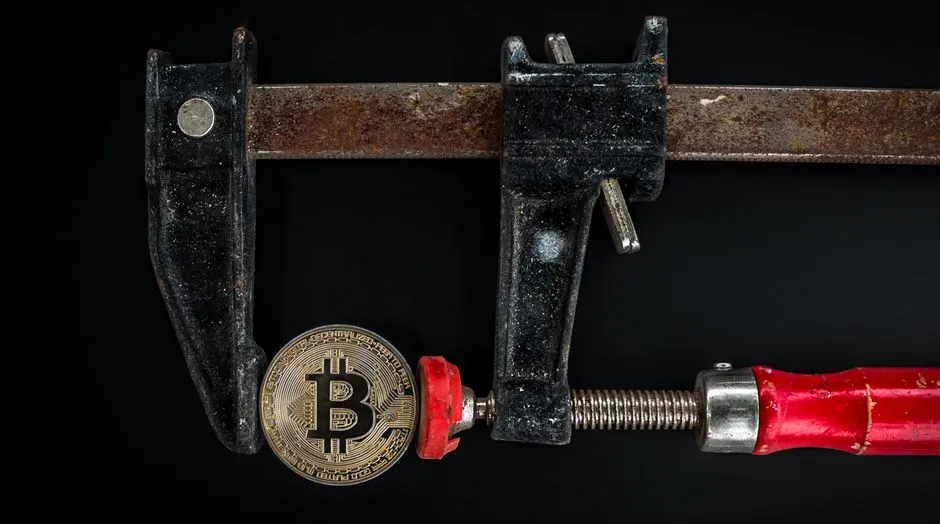
Bitcoin’s mining difficulty has just experienced one of its most significant downward adjustments in recent history, falling by 10.09 percent to 124.93 trillion. This sharp decline marks the 11th largest drop on record, signaling a major shift in how the network’s computational power is currently being deployed. While difficulty adjustments are a routine part of Bitcoin’s design, the scale of this particular drop has caught the attention of miners, investors, and network analysts alike.
What Drives Mining Difficulty Adjustments?
To understand why this drop matters, it helps to first look at how Bitcoin’s difficulty mechanism works. The network automatically recalibrates its mining difficulty every 2,016 blocks, roughly every two weeks. The goal is simple: keep block discovery times hovering around ten minutes regardless of how many computers are trying to solve the cryptographic puzzles. When hashrate (the total computing power dedicated to mining) surges, difficulty rises. When it falls, difficulty drops to keep the system stable.
Why This Drop Stands Out
A 10.09 percent decrease is far from routine. Historically, adjustments hover in the single digits, reflecting gradual shifts in network participation. This time around, the magnitude of the drop points to a significant amount of hashpower being pulled offline simultaneously. For miners, that usually means one thing: profitability has taken a sharp hit, forcing a wave of strategic shutdowns.
The Perfect Storm: Weak Prices and Rising Costs
The primary catalyst for this exodus of mining rigs comes down to basic economics. Bitcoin’s price has been under pressure, compressing the already thin margins that many mining operations operate on. When the market price of Bitcoin dips, the revenue from successfully mining a block drops with it. Meanwhile, electricity costs, hardware maintenance, and facility overhead remain stubbornly high. In a tight market, miners with older, less efficient equipment or those paying premium power rates are the first to flip the switch and go offline.
When Margins Turn Negative
Mining is a volume game, but it is also highly sensitive to operational costs. When the cost to produce a single Bitcoin through mining approaches or exceeds its market value, operators face a stark choice: run at a loss or pause operations until conditions improve. This cycle has repeated throughout Bitcoin’s history, but the current environment adds a new layer of complexity.
How AI Data Centers Are Reshaping the Energy Landscape
One of the most notable developments contributing to this hashpower decline is the rapid expansion of artificial intelligence infrastructure. AI data centers are voracious consumers of electricity, and in many regions, they are outbidding cryptocurrency miners for available power contracts and grid capacity. As utility companies and energy providers prioritize long-term AI deployments, mining operations are finding themselves squeezed out of lucrative energy markets.
The Battle for Grid Capacity
This isn’t just a theoretical shift. In several key mining hubs, facilities have been forced to scale back operations or relocate entirely as power allocations shift toward AI compute farms. The result is a measurable drop in network hashrate, which directly triggered this historic difficulty adjustment. Energy markets are no longer just about supply and demand; they are about competing technological priorities, and right now, AI is winning the bidding war.
What This Means for the Bitcoin Network
For the broader Bitcoin ecosystem, a lower difficulty setting actually has a silver lining. With less computational power competing for block rewards, the remaining active miners can now earn more per unit of electricity spent. This often leads to a stabilization phase where only the most efficient, well-capitalized operations stay online. Over time, the network typically sees a rebound in hashrate as miners upgrade their hardware, renegotiate power contracts, or wait for BTC prices to recover.
Network security remains intact during these adjustments. Bitcoin’s difficulty mechanism was specifically designed to absorb these fluctuations without compromising the blockchain’s integrity. The protocol simply recalibrates until equilibrium is restored, ensuring that blocks continue to be found at a predictable pace.
Looking Ahead: Will Hashrate Bounce Back?
Historical patterns suggest that mining difficulty drops of this magnitude are rarely permanent. Once market conditions improve, or as next-generation mining hardware becomes widely available, idle rigs typically come back online. The key question for the industry is whether the structural shift toward AI energy demand will permanently alter the economics of Bitcoin mining, or if miners will simply adapt by moving to regions with cheaper, more abundant power.
For now, the 11th largest difficulty drop in Bitcoin’s history serves as a clear reminder of the network’s resilience. It also highlights an evolving landscape where cryptocurrency infrastructure must compete alongside other high-demand technological sectors for the same finite resources. As energy markets continue to shift, miners will need to stay agile, and investors should keep a close eye on how these macroeconomic pressures shape the next phase of Bitcoin’s growth.