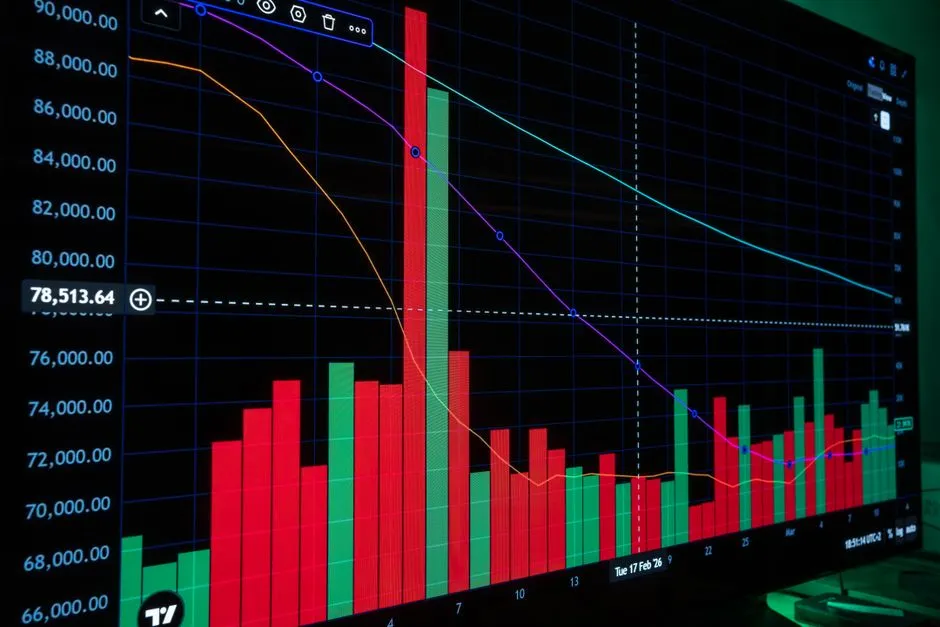
Bitcoin spent Friday’s Asian trading session doing something that many traders had not expected after a sharp overnight move: it settled. After dropping roughly 3% earlier in the cycle, the largest cryptocurrency by market capitalization appeared to enter a consolidation phase, with volatility cooling as investors digested a mix of digital-asset sentiment and broader macroeconomic uncertainty. The backdrop was not calm, though. Stock markets were once again facing pressure from resurgent concerns around the artificial intelligence trade, which has moved from a source of euphoria to a potential source of vulnerability for risk assets.
Why Bitcoin’s Calmer Move Matters
At first glance, a 3% pullback in Bitcoin might not sound dramatic. In the crypto world, moves of that size happen with regularity. What made the recent action more interesting was what came afterward. Instead of continuing to slide with the broader risk-off mood, Bitcoin appeared to find a temporary floor. That kind of behavior often signals a shift in market dynamics, where investors stop reacting purely to fear and begin reassessing positioning, liquidity conditions, and the strength of the underlying trend.
Consolidation is not always a bullish sign, but it can be an important one. After a period of elevated volatility, markets often need time to digest price action. In that sense, Bitcoin’s steadier tone during Friday’s Asia session could be viewed as a pause rather than a reversal. Traders may be waiting for clearer signals before committing in either direction, particularly when other asset classes are showing signs of stress.
AI Anxiety Is Back in the Room
The broader market context is where the story gets more complicated. Stock markets had already been dealing with questions about the sustainability of the AI-driven rally. For much of the past year, artificial intelligence has been one of the strongest narratives in global equities. Companies tied to AI infrastructure, semiconductors, cloud computing, and software have benefited from elevated expectations, and investors have rewarded growth stocks with strong valuations.
But expectations can cut both ways. When a sector becomes central to market performance, any sign of disappointment can trigger a broader pullback. That appears to have been the case during the latest trading session. Resurgent AI fears suggested that investors are becoming more selective, less enthusiastic about paying premium prices, and more sensitive to news that could challenge the pace of monetization or the durability of earnings growth.
How This Affects Risk Assets
Bitcoin has historically been sensitive to macroeconomic conditions. While it is often described as a digital asset with unique properties, its price action still tends to be influenced by liquidity, risk appetite, and the overall tone of global markets. When equities are under pressure, investors often reassess how much risk they want to carry across their portfolios. In some cases, that leads to a sell-off in crypto as well. In other cases, Bitcoin can decouple from traditional assets, especially when the move is driven more by sector-specific concerns than by a broad macroeconomic shock.
The recent session appeared to sit somewhere in between. Bitcoin moved lower, but not in a panic-driven manner. Instead, the price action looked more like a measured adjustment. That distinction matters because it suggests that the market may not be treating this as a systemic risk event, at least not yet. If the AI-related weakness in equities remains confined to a handful of high-profile sectors, Bitcoin may be able to maintain its own rhythm. If, however, the selling spreads to a wider range of growth stocks and begins to affect overall liquidity, the impact could be more pronounced.
What Traders Are Watching Next
Several factors will likely determine whether Bitcoin can build on its consolidation or whether the recent dip becomes the start of a deeper correction. Volume is one of the first things to watch. If selling pressure fades and buying interest returns, that could support a recovery. If volume remains thin, the market may continue to drift sideways until a new catalyst emerges.
Equity market performance is another key indicator. If the AI trade stabilizes and investors regain confidence, risk assets could receive a broader lift. Conversely, if concerns deepen and begin to affect investor sentiment more broadly, Bitcoin may face additional headwinds. The U.S. tech sector, in particular, will remain a closely watched proxy for global risk appetite, given its influence on both market psychology and capital flows.
The Bigger Picture: Crypto Is Not Immune to the Narrative
One of the most important lessons from recent market cycles is that crypto does not operate in a vacuum. Even when the asset class is driven by its own technology, adoption trends, and on-chain activity, it still exists within a broader financial system. Investors are the same investors. Liquidity is the same liquidity. And the narrative risk that can move stocks, bonds, and currencies can also move digital assets.
That does not mean Bitcoin is a simple mirror of the stock market. It is not. But it does mean that the tone set by traditional markets often shapes the environment in which crypto trades. When AI optimism fuels risk appetite, Bitcoin can benefit. When AI concerns trigger a reassessment of growth valuations, Bitcoin can feel the ripple effect. The question now is whether this latest episode will prove to be a brief wobble or the beginning of a more meaningful shift in sentiment.
For now, the most reasonable takeaway is that Bitcoin is in a holding pattern after a meaningful drop. The market is not panicking, but it is not fully confident either. With AI-related concerns once again weighing on equities and investors still calibrating their exposure to growth assets, the next few sessions could be important in determining whether Bitcoin resumes its prior momentum or enters a longer period of adjustment. In a market driven as much by narrative as by fundamentals, the coming days may offer a clearer read on where the balance of power lies.
Related read: China Sets 2030 Target for National Blockchain Network Expansion